Exploring Fiction in the Smoky Mountains
10/25/20254 min read


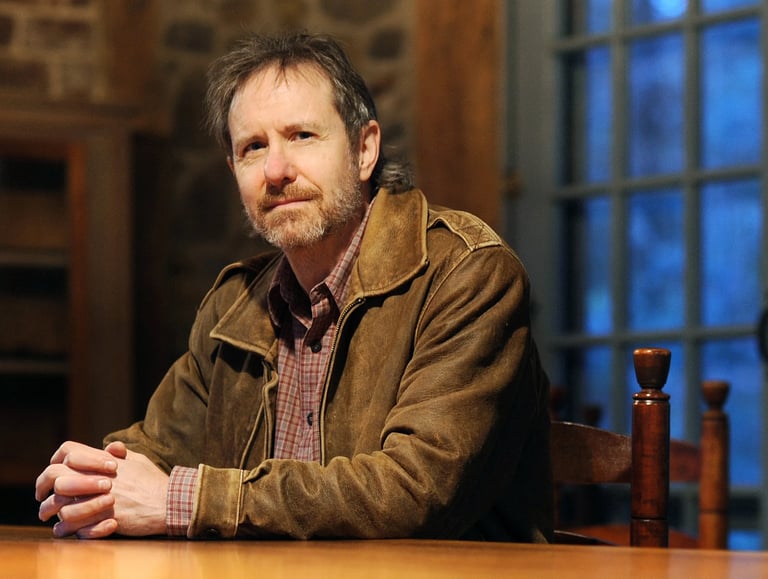
A favorite local author, David Joy is a twelfth-generation North Carolinian who grew up along the Catawba River and has spent over two decades in the rugged mountains of Jackson County, North Carolina. He now lives in the Little Canada community of Tuckasegee with his dog, Edie Munster.
Joy’s writing is inseparable from place. He’s described as “a man who sees his homeplace clearly and who writes like his hand was touched by God” (The New York Times). His work is steeped in the culture, contradictions, and beauty of Appalachia—its grit, grief, and grace.
He studied under Ron Rash at Western Carolina University, and his literary influences include Larry Brown, Daniel Woodrell, William Gay, and Jim Harrison. Joy is also a fly fisherman and outdoorsman, and his 2011 memoir Growing Gills: A Fly Fisherman’s Journey reflects that passion.
David Joy doesn’t just write about Appalachia—he writes from it, with a voice that’s both intimate and indicting. His characters are often trapped by poverty, addiction, and legacy, but his stories never lose sight of their humanity.
Some reviews of David's works
Those We Thought We Knew (2023)
• Kirkus: “An emotionally complex procedural that goes to unexpected places”.
• Pursuit Magazine: A powerful blend of small-town mystery and social reckoning. The novel follows Toya Gardner, a young Black artist whose protest art ignites racial tensions in a North Carolina mountain town. The story weaves together multiple perspectives—Toya, a conflicted sheriff’s deputy, and a retiring sheriff—as they confront buried histories and systemic racism.
• Wilmington NC Magazine: Joy calls this “the book I was put on this planet to write.” It took over a decade to complete and centers on themes of generational trauma, the role of the Black church, and the power of art as resistance.
When These Mountains Burn (2020)
• A Dashiell Hammett Award winner, this novel tackles the opioid crisis in western North Carolina. It’s a raw, urgent story of grief, addiction, and justice, praised for its emotional intensity and moral complexity.
The Line That Held Us (2018)
• Winner of the Southern Book Prize. A tale of loyalty, vengeance, and survival, it begins with a fatal accident in the woods and spirals into a brutal reckoning. Critics lauded its pacing and Joy’s ability to evoke Appalachian landscapes and moral ambiguity.
The Weight of This World (2017)
• A bleak, violent, and deeply human story of two war-scarred men and a woman trying to escape their pasts. Joy’s prose is described as “lyrical and unflinching,” with comparisons to Cormac McCarthy and Daniel Woodrell.
Where All Light Tends to Go (2015)
• Edgar Award finalist. A coming-of-age noir set in a meth-ravaged Appalachian town. Readers on Goodreads praise its haunting final lines and the protagonist’s voice: “Only the middle ground of this wicked world mattered, the vast gap that stretched between, and those who were born with enough grit to brave it”.
Another favorite is Ron Rash. Ran into him at City Lights Bookstore just last week. He isn’t just a writer of Appalachia—he’s one of its most faithful stewards. Though born in South Carolina in 1953, Rash’s heart and heritage are rooted in Jackson County, North Carolina, where his family has lived for over 250 years. His grandfather worked in the paper mill in Sylva, and Rash himself spent formative years wandering the woods and creeks of the region, absorbing its rhythms, stories, and silences
Rash often says he writes “to preserve a vanishing world.” That world is Jackson County’s—its hardscrabble beauty, its moral complexity, its people who carry both trauma and grace. His fiction doesn’t romanticize the mountains; it renders them with poetic precision and emotional truth. Whether it’s the haunting stillness of a trout stream or the quiet desperation of a mill town, Rash captures the soul of Western North Carolina with reverence and grit.
As the Parris Distinguished Professor of Appalachian Cultural Studies at Western Carolina University in Cullowhee, Rash has mentored generations of writers and thinkers. He’s not just teaching literature—he’s teaching legacy. His presence on campus is a living bridge between Jackson County’s past and its creative future.
From Serena to Burning Bright, Rash’s work is steeped in the moral fog and lyrical clarity of mountain life. His characters often face impossible choices—between loyalty and survival, tradition and change. And always, the land is a character too: unforgiving, sacred, and deeply alive.ust a few reviews from just a bit of his works.
The Caretaker (2023)
Set in 1950s Blowing Rock, NC, this novel explores friendship, class, and betrayal through the eyes of Blackburn Gant, a cemetery caretaker disfigured by polio.
• Kirkus: “Among his best… Rash writes with finesse and affection, but there’s flint beneath the nostalgia”.
• FictionFan: “A simple story made unbearably tense by Rash’s emotional precision… The dead could do nothing worse to him than the living had already done”.
• Goodreads: 4.17 stars from over 10,000 ratings. Readers praise its emotional depth and Appalachian setting.
• BookBrowse: “A tender examination of male friendship and familial devotion… Rash fills in each character’s psychological motivations with care”.
Serena (2008)
A dark, Shakespearean tale of timber barons in Depression-era NC. Serena Pemberton is one of literature’s most ruthless women
• Kirkus: “A fine melodrama… Rash shows reverence for nature even as his characters despoil it”.
• Goodreads: 3.55 stars from 36,000+ ratings. Readers are divided—some hail it as a masterpiece of Southern Gothic, others find Serena too inaccessible.
• LibraryThing: “The superstition of the mountain people was thick and almost a character itself… Serena is chilling, mythic, and unforgettable”.
Burning Bright (2010)
Short stories spanning Civil War to present-day Appalachia. Themes include meth addiction, isolation, and moral reckoning.
Highlights:
• Kirkus: “A nicely varied feast from a master of the form… Rash evokes suffering without beating up his readers”.
• Goodreads: 4.11 stars. Readers praise its lyrical prose and emotional punch.
• Reader Review: “Each story is a gem… Appalachian despair rendered with brutal beauty”.